
If you’ve ever worked in advertising or communications, you know that creativity rarely happens in a straight line. Between drafting campaign copies, editing visual design projects, and balancing strict launch dates, keeping track of moving parts can quickly become overwhelming.
As I kicked off week 4 of my junior year, I hit a wall. My strategy of relying on sticky notes and memory was no longer working. I needed something dedicated to handling my complex schedule and assignments without slowing me down. Research from the Project Management Institute (PMI) shows how having standardized workflows can improve project success and reduce stress. As someone who aims to work in advertising, I’ve realized this applies just as strongly to my college coursework as it does to running major agency campaigns. Here is how I explored different platforms, built out my system in ClickUp, and transformed how I approach my work.
In the advertising world, project management applications aren’t just checklists, but they’re digital workspaces where strategy meets visual design. I spent time evaluating a few industry favorites, including Asana, Trello, and ClickUp. Harvard Business Review emphasizes that choosing tools that reduce context-switching and keep information centralized is important for maintaining creative flow. While Trello’s Kanban boards are straightforward and Asana works for general task mapping, ClickUp ultimately felt like the best fit for me.
What I loved about ClickUp was its flexibility and customizability. In communications, a single project often involves multiple steps, research links, and many drafts. ClickUp allows you to create subtasks inside parent tasks while attaching rubrics and graphics directly inside the task folder. It gave me a good mix of high-level overview and step-by-step details.
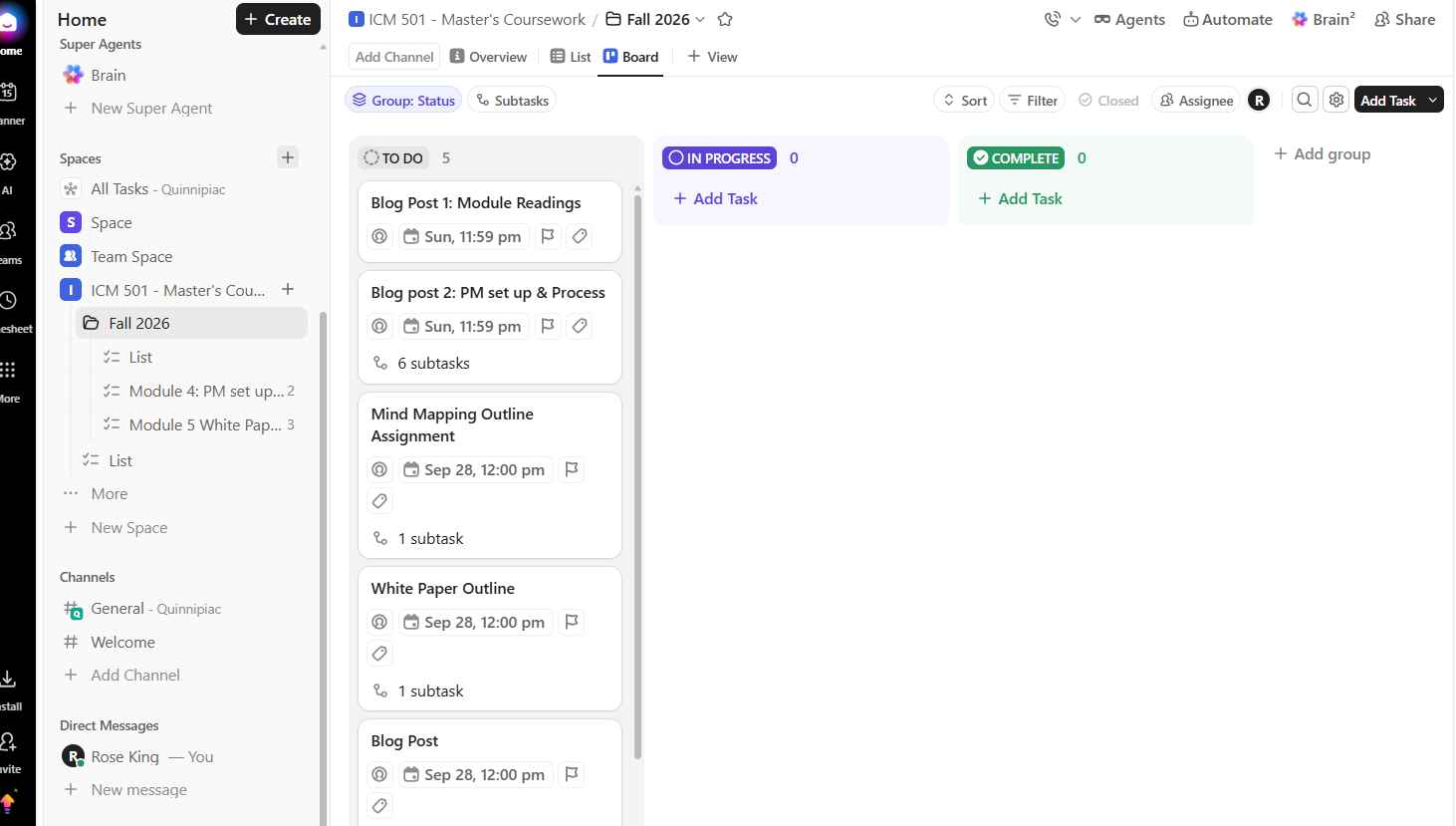
Turning ClickUp into my personal planner required a very intentional approach. I established a clear structure by creating a dedicated course workspace within my Fall 2026 Term folder and organizing my coursework into specific module lists. I also swapped vague task headers for actionable subtasks. Normally, I start my week by writing down every single assignment in my notebook, which instantly leaves me feeling overwhelmed. Being able to check off smaller milestones in ClickUp gave me genuine peace of mind that I could get everything done on time. I also set up due dates with buffer time, which was especially helpful since I have always had a habit of procrastinating.
Switching to ClickUp in Board View completely shifted my daily workflow. Seeing my modules organized into clean, visual steps gives me immediate clarity over what is pending, what is in progress, and what is ready to submit. More than just an organization tool, setting up this system forced me to practice deep focus and intentional planning. In Chapters 8 and 9 of Stolen Focus, Johann Hari explores how achieving a state of “flow” requires clear, defined goals and single-minded focus without constant task-switching. Since creating this system, I have found that my weeks feel much more organized and less stressful.
Ultimately, I realized that being organized does not mean giving up creativity. If anything, having a system in place has given me more room to focus on the creative side of my work instead of constantly worrying about what I might be forgetting. ClickUp may not be the perfect solution for everyone, but building a system that works for me has made managing my coursework feel much more manageable. As I continue working toward a career in advertising and communications, I know that learning how to balance creativity with organization will be just as important as the creative skills themselves.


Leave a Reply