
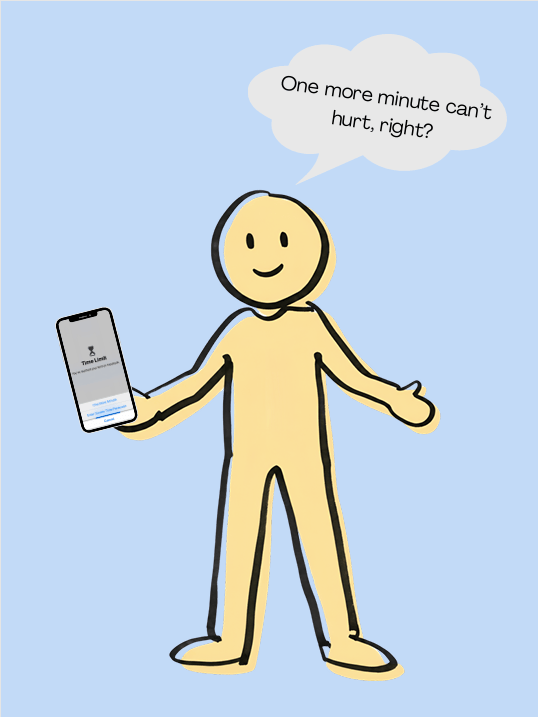
About a year ago I had the same realization that many of us have. I spend way too much time on my phone. In that moment, I took it upon myself to try and fix this problem. Ironically, I saw an ad for an app that was supposed to stop you from scrolling, while I was scrolling. After downloading the app and seeing it required a monthly fee, I immediately deleted it. I researched other strategies and landed on adding a time limit on social media apps through settings. Perfect! A way to remind me that I have spent over an hour scrolling. Later that day, mid-scroll, a big timer appeared on my screen. You have reached your limit for today. I was disappointed yet relieved to see three options below that message. Ignore for 1 minute. Ignore for 15 minutes. Ignore for today. Of course, my 1 minute turned into 15 minutes and that turned into the entire day. To this day, I still have the screen time setting. It has become a habit to click ignore for today, but I refuse to change the setting. This week I decided to explore why these quick-fix tools feel like such a scam, and how we got stuck thinking an individual band-aid could fix an environment built to break our focus.
It didn’t take long to realize I wasn’t the only one doing this. Look around any room, and almost everyone has some version of a screen-time hack they’re actively ignoring. Grayscale mode, app blockers, phone lockboxes, or strict daily limits they bypass five minutes in. We’ve been told this idea that if we just had a little more self-control, we could effortlessly disconnect. But as Johann Hari points out in Stolen Focus, telling people to fix their attention spans with self-help tricks is like handing someone in a polluted city a desk fan and telling them to just breathe deeper. It ignores the actual world we’re walking around in every day.
When you look at how our digital spaces are designed, it becomes obvious that we never stood a chance on discipline alone. We are walking around in a world designed by thousands of developers and companies with a strong incentive to keep our eyes on a screen for as long as possible. A recent article in Scientific American by Jackie Flynn Mogensen breaks down the science behind this, featuring Stanford professor Dr. Bradley Zicherman who compares social media feeds to slot machines. You pull down to refresh, never knowing if you’re going to hit the jackpot with a good post or video, so you just keep pressing the button. Infinite scrolling, autoplay, and algorithms are designed to keep us coming back for the next post, video, or notification. Expecting yourself to effortlessly switch off and focus deeply while living in a hyper-stimulating world is setting an impossible standard.
So where does that leave us? If personal app-lockers are like band-aids, the goal shouldn’t be forcing ourselves into rigid discipline. It’s about changing our physical environment instead of constantly fighting our own minds. NPR’s Life Kit similarly recommends creating structural boundaries, like keeping your phone out of reach during focused work or creating phone-free spaces at home. Focus isn’t something you force through mentality, it’s something that naturally returns when you calm your surroundings down enough for your brain to drop its guard.
The next time you find yourself hitting “ignore for today” don’t beat yourself up. You aren’t failing a test of character. You’re just living in a world engineered to keep you looking. The fix isn’t downloading another app or beating yourself up over hours of scrolling. It’s figuring out what ways give your brain the grace, space, and quiet environment it needs to breathe.


Leave a Reply