
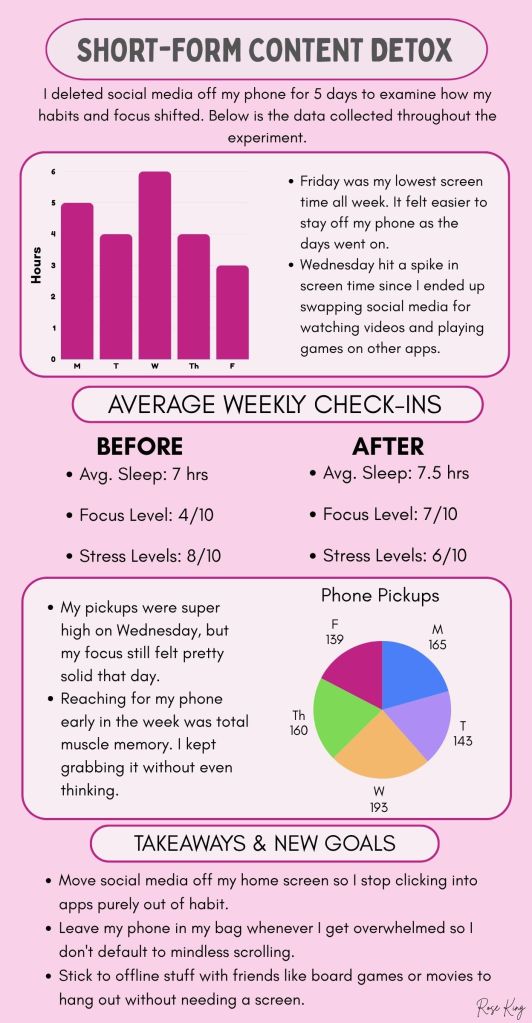
If you are ever wondering how addicted to your phone you truly are, try a digital detox. I’ve become ashamed of how much I automatically open an app on my phone. Specifically, TikTok and Instagram. This week I decided to start my scrolling rehab. Yes, it is a rehab. Of course it sounds a little dramatic, but the amount of withdrawal I’ve felt this week from not watching videos of dancing cats or influencer “get ready with me” routines has been disappointing. Rather than solely relying on willpower, I decided to treat these five days as a personal research project. I’ve tracked every single urge to reach for my phone, noticed what I was feeling at that exact moment, and paid attention to what happened when I forced myself to sit in the quiet instead.
The first two days were an uncomfortable lesson in just how deeply engineered my screen habits really are. Without a feed to refresh during small moments of boredom, like waiting in line for coffee or sitting between classes, I was forced to face quiet downtime. Every time temptation struck, I forced myself to pause and find an alternative stimulation. I opened a physical book to read a quick chapter, caught up on TV series, or pulled out my notes app to write down my exact mood. What I noticed almost immediately was that I rarely reach for my phone out of a genuine desire to see what’s on it. I reach for it to avoid feeling bored, anxious, or when I am stuck on a challenging task. Stripping away that instant dopamine hit exposed just how uncomfortable plain, uninterrupted silence can feel when you are not used to it.
To try and make sense of what I was observing in my own behavior, I began my research on attention and technology. In Chapters 6 and 7 of Stolen Focus, Johann Hari explains how app designers build these platform features on purpose just to hook our attention. Feeling that withdrawal firsthand made his points hit way too close to home. My attention span didn’t just naturally get worse over time. It felt like my brain had been trained to panic and grab for quick stimulation the second things got quiet. Reading Liz Leatrice’s essay, “The Year Is 2063, and You Were Never [Interesting]”, was also quite eye-opening. Leatrice explores how easily a life full of potential gets quietly consumed by endless scrolling and living vicariously through other people’s feeds. Reading her piece alongside my own journal entries made me reflect on how much time I spend watching other people live their lives instead of fully enjoying my own. It made me realize how often my phone serves as an automated reflex used to avoid even thirty seconds of boredom.
To track these behavioral patterns visually, I investigated the work of graphic designer Nicholas Felton. As profiled by Margaret Rhodes in WIRED, Felton spent a decade obsessively tracking every detail of his daily life, from the places he went to the songs he listened to and turned all that data into visual art. Inspired by his approach and the hand-drawn style of Giorgia Lupi and Stefanie Posavec’s Dear Data project, I started sketching out my own detox chart. Instead of using a boring spreadsheet, I’ve been drawing out a visual map that tracks how I was feeling right alongside the exact times of day my phone cravings spiked.
Tracking these urges transformed my phone usage from a mindless reflex into clear, meaningful feedback. Removing my biggest digital distractions significantly cut down on constant task-switching throughout the week, allowing me to complete assignments in focused, uninterrupted stretches that I had not realized I was missing out on. Most importantly, taking a moment to write down the urge created a pause between the initial impulse and my physical reaction. Moving forward, my goal is not to abandon technology entirely or delete every app I own, but rather to develop enough self-awareness so that whenever I do pick up my phone, it is a conscious decision rather than an automatic reach.
Ultimately, this five-day experiment wasn’t about achieving digital purity or pretending I’m going to live offline forever. It was an exercise in reclaiming ownership over my own time. Social media feeds will always be engineered to pull us back in, but creating a tiny buffer of mindfulness for myself makes it possible to catch the reflex before it takes over. Moving forward, keeping that awareness intact will be an ongoing project, but at least now I know what it feels like to sit in the quiet and actually thrive there.


Leave a Reply