
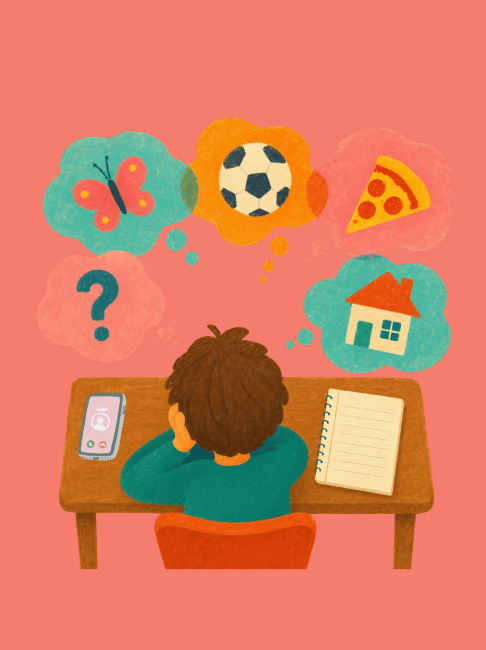
Recently, I was asked to observe a piece of art for 10 minutes straight. No talking, no scrolling, just me and my thoughts. As a couple of minutes went by on the timer, I received a notification on my phone. Determined, I left my phone alone and continued observing. Students hustled by me to class, more notifications went off, and the task of sitting still became increasingly harder. As time went by, I was sure it had already been more than halfway. When I finally glanced at the timer, hoping to see a number close to 10, it read 4:14. I wasn’t bored because the painting was uninteresting. I was uncomfortable because I wasn’t being constantly stimulated. In that moment, I asked myself something. When did the easiest task of doing nothing become the most challenging one of all?
My difficulty focusing on a painting led me to a whole world of questions. Is my attention span the problem? Am I accustomed to being interrupted by outside sources? What has happened to the way we pay attention? My experience with testing my focus made me realize how easy it has become to be sidetracked. In today’s world, there is always something else trying to grab your attention. Society has not made it any easier to break this habit of stimulation either. Movies, songs, and short-form content are all crafted towards short attention spans. Recent research even suggests that short‑form content may actively lower our ability to focus, reinforcing the very patterns I noticed while staring at that painting.
The attention span test made me realize that my experience with the painting was more than just a moment of distraction. It showed me how quickly my mind searched for something else to keep me stimulated. Instead of sitting comfortably with my own thoughts, I found myself noticing every sound and movement around me, hoping for a reason to look away. That realization pushed me to think about how much I rely on outside stimulation without even noticing it. Whether I am doing homework, waiting in line, or sitting with friends, there always seems to be something filling the silence. Research from the American Psychological Association highlights how digital distractions significantly impair sustained attention, which mirrors exactly what I felt during those ten minutes.
Coming across Johann Hari’s Guardian piece, “Your attention didn’t collapse. It was stolen”, completely changed how I looked at my own habits. Constantly getting sidetracked isn’t just a personal flaw or a lack of willpower. Our environment has become tailored to sabotage our focus. Every single buzz or pop-up breaks our concentration, and getting back into the flow takes way longer than we realize.
Hari’s breakdown hit too close to home. I’ll sit down fully intending to finish a project, only for one text notification to completely alter my momentum. What starts as a quick reply to a friend instantly spirals into half an hour of mindless scrolling, leaving me questioning how much control I actually have over my attention.
My ten minutes with that painting revealed something to me that was much deeper than I expected. After learning how much my attention span was conditioned by constant stimulation, I started noticing it in everything I did: the way I check my phone while doing homework, how quickly I reach for distraction when a moment feels too quiet, and how rarely I sit with my own thoughts without reaching for something else. The more I researched the effects of digital distraction, the more I understood why rebuilding my attention span matters. Studies show that fractured focus doesn’t just make us less productive, but reshapes how we think, create, and process the world around us. For a generation that’s expected to think creatively and stay connected, learning how to sit with our own thoughts may become one of the most necessary skills we can have.


Leave a Reply